
New publication: Multilayered MXene/Pristine Carbon/Biomass Cellulose Film Electrode with Ultrahigh Volumetric Capacitance for Symmetric Flexible Supercapacitor
Chem. Methods; Vol. 5, Issue 11, 2025
Title
Multilayered MXene/Pristine Carbon/Biomass Cellulose Film Electrode with Ultrahigh Volumetric Capacitance for Symmetric Flexible Supercapacitor
Abstract
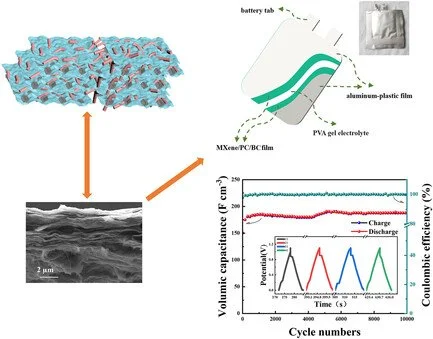
2D MXenes have garnered significant attention in energy storage due to their high volumetric capacitance. However, their practical application is hindered by the restacking of MXene layers. Herein, a novel strategy to address this challenge by constructing a multilayered sandwich-structured MXene/biomass pristine carbon (PC)/biomass cellulose (BC) composite film with a hierarchical network architecture is reported. The 1D BC nanofibers act as mechanical bridges, interlinking MXene sheets and PC particles to form a robust, flexible network, thereby improving mechanical flexibility and creating interconnected ion-transport channels. This architecture not only prevents MXene restacking but also facilitates electrolyte infiltration and ion diffusion, owing to expanded interlayer spacing (14.5 Å) and a substantially increasing specific surface area (526.4 m2 g−1). The optimized MXene/PC/BC-1 film exhibits an ultrahigh volumetric capacitance of 1225.1 F cm−3 at 1 A g−1, three times higher than that of pure MXene (407.0 F cm−3). A symmetric flexible soft-pack supercapacitor fabricated with this composite film achieves 83.8 mWh cm−3 energy density at 5.3 W cm−3 and retains 98% of its initial capacitance after 10 000 cycles. This work demonstrates the synergistic combination of biomass-derived materials with MXene, offering a sustainable, scalable strategy for flexible energy storage devices.